
Arctic Voices 2024: A Retrospective
In autumn 2024, things turned “Arctic” in Bern. While the exhibition Polwärts at the Kornhausforum offered “deep insights into the Far North,” and shortly before the opening of Greenland. Everything Will Be Different at the ALPS Alpine Museum of Switzerland, the film and event series Arctic Voices: Indigenous Perspectives on Pasts, Presents and Futures took place for the first time from 27 September to 22 October.
The series was accompanied by an exhibition of the same name at the Museum of Contemporary Circumpolar Art (MCCA), which remained on view until 8 February 2025. Over the course of nearly a month, Arctic Voices hosted 18 events across nine different cultural venues in Bern. More than 20 artists and guest speakers took part, and the programme attracted over 800 visitors.
The first edition of Arctic Voices was a success through and through – an achievement that would not have been possible without the many co-thinkers and visionaries who contributed to it. Our deepest thanks go to the Arctic Voices Projektwerkstatt, all our collaborators and event partners, visitors, and friends of the festival. What follows is a reflection on a highly engaging, diverse, musical, and socially relevant programme, as well as a summary of what we learned.
Planning Process
The first visions for Arctic Voices emerged in late 2023 within a small group of collaborators. The initial idea was to organise a small film series in Bern in autumn 2024 focused on Indigenous perspectives and stories from Arctic regions. As more people and groups became involved in early 2024, the project quickly grew into a full month-long programme including film screenings, concerts, workshops, panel discussions, and an exhibition. The general orientations and goals of the project were discussed and developed collectively in a semi-public Projektwerkstatt, which met roughly once a month and served as a space where personal networks were activated and programme content further developed.
While responsibilities for curating and organising individual events were distributed early on among members of the Projektwerkstatt, overall coordination, communication, and fundraising remained the responsibility of the initiating team. Major challenges included prolonged financial uncertainty, underestimated organisational workload, and limited time resources within the core coordination team. Still, thanks to these shared collective efforts, a high-quality and impressively diverse programme was ready to launch by the end of September. Below, we share selected insights.
Impressions
Events at the MCCA
Arctic Voices kicked off on 27 September with an opening reception at the Museum of Contemporary Circumpolar Art (MCCA). This vernissage marked the beginning of both the broader programme and the MCCA’s new temporary exhibition, which featured contemporary artworks from various circumpolar regions and offered visitors the opportunity to engage with pressing issues facing the Arctic and its inhabitants through February 2025.
Among the exhibited works were wax sculptures by Sámi artist Jo Morten Kåven, who also designed the logo for Arctic Voices. He was present at various events at the museum and introduced visitors to the meanings and stories behind his work.
Following an evening with Lewis Cardinal (Woodland Cree, Canada) on “Indigeneity and Indigenuity” and a talk and concert by Sámi artists Berit Alette Mienna and Øistein Hanssen, the closing event of Arctic Voices also took place at the MCCA. On 22 October, the event “From Trauma to Transformation: A Transdisciplinary Workshop” focused on memory cultures, political recognition and reparation, the situation of Indigenous communities in Canada, and parallels to the historical forced assimilation of Jenish, Sinti, and Roma people in Switzerland. Strategies of resistance, transnational cooperation, and forms of solidarity were discussed collectively.
Marja Mortensson Trio
Arctic Voices had a highly visible public launch on 30 September with a screening of the Swiss film Beyond Tradition at the Cinématte, followed by a sold-out Joik concert by Norwegian Sámi artist and film protagonist Marja Mortensson and her band at Mahogany Hall Bern.
In the film discussion, director and ethnomusicologist Lea Hagmann spoke about how her film builds bridges – between different vocal traditions such as Swiss natural yodelling, Georgian polyphony, and Sámi Joik; between geographic and cultural contexts; and between academia and artistic practice – with the aim of making research more accessible through the medium of film. Marja Mortensson, one of the three protagonists of the film, shared how important it is for her as a Sámi artist to revitalise the long-suppressed traditions of Joik and the Sámi language for future generations – and to share them through a film like Beyond Tradition.
Indigenous Rights
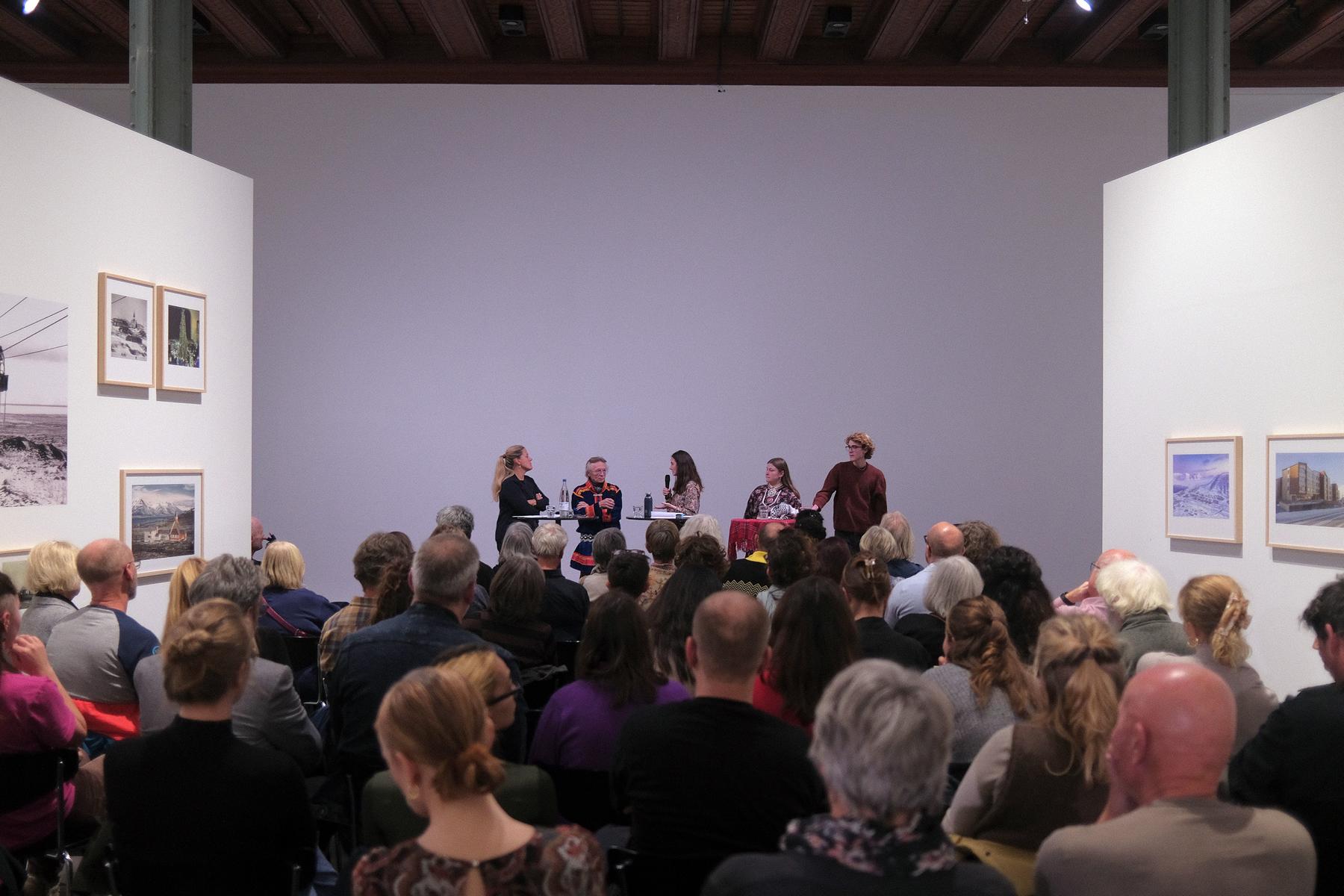
On 11 October 2024, the event “Conflict Zone Arctic: Indigenous Rights and Geopolitical Interests” took place at the Kornhausforum Bern, in collaboration with the Polit-Forum Bern and the Society for Threatened Peoples. After a screening of the Finnish film Home River, a panel of experts – including Sámi politician Lars Anders Baer, Swiss Arctic Council Ambassador Alexandra Baumann, climate strike activist Cyrill Hermann, and Elle Rávdná Näkkäläjärvi, Chair of the Sámi Parliament’s Youth Council in Norway – discussed the challenges facing Indigenous communities, particularly the Sámi, in light of geopolitical tensions and climate change.
The discussion highlighted the need to protect Indigenous rights and ensure their self-determination, while also touching on Switzerland’s role, as it has held observer status in the Arctic Council since 2017. Around 140 people attended the event.
Workshop with Alisi Telengut
On 17 October, filmmaker Andrea Bordoli (Institute of Social Anthropology, University of Bern) and Flora Gerber (Ciné Liminal) organised an animation workshop with Canadian-Mongolian artist Alisi Telengut. In an intimate session at Living Room Bern, Telengut introduced participants to the technique of “under-the-camera animation.” The workshop concluded with the creation of a collaborative short animated film.
That same evening, the film collective Ciné Liminal screened short films by Telengut and two other Canadian filmmakers at the Reitschule cinema. In the subsequent conversation with Alisi and Canadian filmmaker and actress Elle-Máijá Tailfeathers, who joined via video call, they discussed Indigenous languages, cultures, identities, rituals, and spirituality – their suppression through state assimilation policies and residential schools, as well as their resilience, strength, and resurgence today.
Conclusion and Outlook
We consider the first edition of Arctic Voices in autumn 2024 to be a great success. The programme achieved a high level of diversity, quality, and density – both in terms of content and in terms of cultural formats, including exhibitions, film screenings, concerts, lectures, workshops, and political discussions. As a result, we reached a wide audience across different interest groups and age ranges.
More than a purely entertainment-focused event, Arctic Voices offered an in-depth engagement with the histories, cultures, and lived realities of Indigenous peoples in Arctic regions – while also making connections to global contexts and to Switzerland, for example in relation to resource extraction, climate change, minority rights, and state practices of assimilation and coercive welfare measures.
We believe it is highly relevant for Switzerland, too, to engage with Indigenous perspectives and Arctic regions. For this to be meaningful in the context of Arctic Voices, several foundational conditions had to be met. These included relying on and expanding existing personal and institutional relationships with Indigenous artists and organisations, as well as designing the programme through dialogical approaches, feedback mechanisms, and a high degree of cultural sensitivity. The programme and its development followed an inquisitive, research-oriented approach and repeatedly highlighted the connections between its topics and Switzerland. Throughout, Arctic Voices positioned itself in solidarity with Indigenous peoples and their concerns.
A sustainable continuation of Arctic Voices ultimately depends on personnel and financial resources. What is needed is a more broadly supported funding base with longer lead times, optimised workflows, clearer responsibilities, and more allocated capacity for cross-festival tasks such as communications, administration, and accounting. Given the overwhelmingly positive feedback from audiences, contributors, institutions, and participating artists and “voices,” a continuation of Arctic Voices is certainly desirable. While this year placed a particular focus on the Sápmi region of Northern Europe, future editions could engage more deeply with regions such as Canada, Alaska, Greenland, and parts of Russia.
Arctic Voices was many things, but above all, it was again and again a collectively shaped space of encounter and learning – one in which even unexpected connections could suddenly and visibly emerge.
Mit freundlicher Unterstützung von:


